As enterprises expand their business globally, training managers need to deliver unified, standardized instructional content in multiple languages while controlling production costs. With artificial intelligence (AI) tools, voice-over translation and subtitle generation can be completed within hours, significantly reducing reliance on professional recording studios for re-recording.
Translation output quality varies depending on language combinations and content complexity. If training content involves safety procedures or compliance requirements, relying solely on automated translation is insufficient. Before official publication, professional human reviewers must verify compliance and expression accuracy.
How to Choose AI Training Video Translation Tools
A high-quality AI training video translation tool should not only deliver accurate AI translation results but also support standardized localization processes within an enterprise's existing training workflows.
Platforms must accurately translate technical terminology and generate reliable transcripts. Enterprises should prioritize AI tools that can automatically complete video translation while supporting human review for high-risk content.
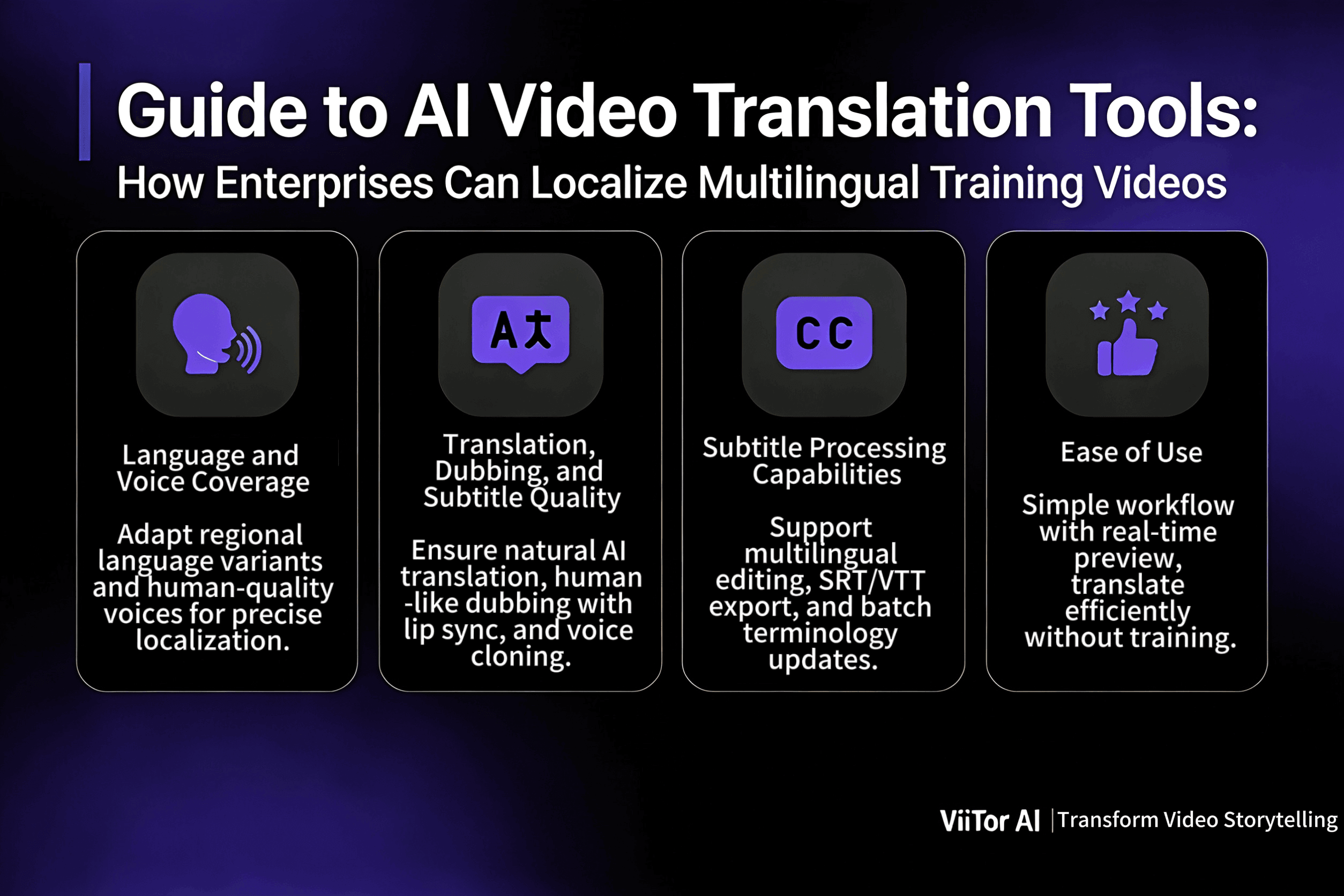
Language and Voice Coverage
To achieve scalable AI translation applications, platforms must support the markets enterprises actually serve. Many vendors claim to support numerous languages, but truly effective localization depends on adapted regional language variants and available human-quality voices.
Tools should cover both current business operations and markets planned for expansion within the next 1–2 years, such as distinguishing between Brazilian Portuguese and Latin American Spanish. If voice accents are stiff, unnatural, or mismatched with scenarios, learners will quickly lose interest, and training content will lose its professionalism and credibility.
Translation, Dubbing, and Subtitle Quality
Video translation quality directly determines whether learners trust the learning content or perceive it as mechanical output. AI translation should deliver natural, fluent expressions in the target language, not mechanical word-for-word translations.
Voice-overs must possess human-like quality with steady pacing and tone matching the original trainer. When people appear on screen, lip movements must synchronize closely with the new audio, and voice cloning technology should preserve the trainer's distinctive voice characteristics. Before selecting a platform, it's recommended to translate a 1–2 minute sample and have native speakers evaluate its authenticity and naturalness.
Subtitle Processing Capabilities
Subtitle management directly affects content clarity and accessibility across different platforms. AI platforms chosen by enterprises should automatically generate subtitles for all selected languages and provide editors supporting direct adjustment of subtitle text and timelines within the tool.
Platforms must support SubRip (SRT) and WebVTT formats for integration with Learning Management Systems (LMS), while supporting on-demand hard-coded subtitles in videos. They should also provide subtitle position control to avoid obscuring operation steps in software demonstrations and support rapid batch updates of terminology throughout the text.
Ease of Use
Ease of use directly determines whether teams genuinely adopt AI translation or abandon it after one attempt. Platforms should provide clear, simple workflows: upload file → select language → translate → review → export, without requiring repeated operations in complex settings.
Clean interfaces and real-time preview features enable quick audio verification and transcript adjustments. Reasonable default settings allow first-time users to produce usable results without additional training. An ideal tool should enable trainers to complete a basic translation within 10–15 minutes; otherwise, it will be difficult to integrate into busy training workflows.
Top AI Platforms for Translation, Localization, and Training Videos
The best AI platforms for translation, localization, and training video production provide seamless workflows supporting scaled multilingual content creation. These platforms automatically complete key tasks such as voice cloning, dubbing, and subtitle generation, effectively saving time and reducing costs.
With support for multiple global languages, they ensure brand messaging remains consistent and accurate across regions. Such tools are ideal for e-learning, corporate training, and marketing teams, easily integrating into existing workflows to help teams efficiently produce localized videos without extensive manual editing.
ViiTor AI
ViiTor AI provides professional translation and localization services for training teams seeking efficiency without sacrificing editing control. Users can directly upload videos to generate AI translation results in 19 languages and optimize content through built-in transcript editors—all within a single platform without switching between tools.
Voice cloning technology precisely preserves trainers' voice characteristics across languages, combined with lip-sync alignment technology to effectively reduce visual incongruity of on-screen characters. This continuity of voice and image is particularly important for learners already familiar with the instructor, enhancing learning affinity and recognition.
For multilingual training projects, ViiTor AI integrates subtitle generation, dubbing, and export functions within a single environment, significantly reducing time and communication costs from switching between multiple tools. Line-by-line editing and precise timeline control enable correcting terminology deviations before content publication, while team workspaces provide convenient support for collaborative review.
Its publicly disclosed security management mechanisms and compliance assurance capabilities precisely match enterprise-level management requirements, ensuring training content processing remains secure and compliant.
Advantages
- Dubbing and subtitle tasks integrated into a unified workflow, enabling efficient and simple operations
- Rapid completion of multilingual version updates when content changes, adapting to iteration needs
- Preservation of instructor voice and image consistency across regions, strengthening brand recognition
Smartcat
Smartcat provides one-stop translation and localization management for training teams seeking strict control over global release processes. Its AI agents complete transcription, translation, and synchronized dubbing within structured workflows, reducing frequent handoffs between tools and external vendors.
Users upload files, set target languages, and review results in real-time subtitle editors, supporting instant adjustments to text and timelines. Real-time preview capabilities enable quick corrections before content reaches learners.
The platform supports 280+ languages and 80+ file formats, including MP4, SRT, and VTT, simplifying Learning Management System (LMS) deployment. Multi-speaker detection enhances subtitle accuracy for roundtable courses or instructor-led modules, reducing expression ambiguity in localized versions.
Hard-coded subtitles and AI dubbing accelerate market launch, avoiding post-production delays. Collaboration tools enable internal reviewers or external language experts to optimize terminology directly within the workspace, ensuring consistency across large training libraries.
Advantages
- Single account management for 280+ languages
- Compatibility with multiple multimedia formats including MP4, MP3, MOV, SRT, VTT
- AI agents that continuously learn and improve based on feedback
- Accurate and reliable translation
Limitations
- Requires establishing standardized review processes for high-risk compliance content
- Cloud environment depends on stable network connectivity
Vizard
Vizard supports uploading original content and selecting target languages to generate subtitles or translated audio through efficient AI video workflows. The platform supports audio dubbing in approximately 30 languages and subtitle translation in 30+ languages, enabling multilingual adaptation without standalone video translation tools.
It can automatically transcribe speech, edit subtitles in browser interfaces, and export clips adapted for YouTube, TikTok, and Instagram, or publish directly to these platforms. The closed-loop workflow enables teams to quickly generate publishable content from raw recordings.
Beyond language translation, Vizard provides editing features for trimming webinar videos, removing redundant segments, and splitting long videos into short clips. Scheduled publishing and AI subtitle generation features support cross-social-channel distribution planning.
For enterprises producing tutorial videos or lightweight training courses, multilingual training videos for global audiences can be created using AI without building complex systems.
Advantages
- Free trial available to test AI video translation effectiveness before budget commitment
- Browser-based one-stop integration of editing, subtitles, and scheduled publishing
- AI automation capabilities supporting rapid short video production and delivery
Limitations
- Fewer enterprise-level management features than professional localization platforms
- Limited advanced language control capabilities for complex compliance or specialized content
Clueso
Clueso employs advanced AI designed specifically for the training industry to transform screen recordings into structured training videos and written guides. After users record operation procedures, the system automatically transcribes actions, organizes steps, and generates synchronized voice-overs. Magic translation features support 20+ languages, enabling multilingual adaptation of tutorial videos without manual reconstruction.
The platform automatically applies brand styles and formats during processing, reducing post-production workload. Clueso's AI voices cover all supported languages, helping teams produce multilingual materials consistent with original content style and tone.
Users can finely adjust scripts, control speech speed, and export directly publishable multilingual versions. Teams can produce multilingual videos for global training projects while ensuring consistency across multilingual versions.
Advantages
- Single recording simultaneously generates videos and step-by-step illustrated guides
- Automatic screen zooming, silence trimming, and brand integration without manual editing
- Guides can be integrated into support tools or internal knowledge bases, accelerating deployment
Limitations
- Lower-tier plans have usage quotas limiting large-scale production
- Limited advanced cinematic editing features for complex post-production
AI Studios
AI Studios can replace live trainers with virtual avatars to generate AI videos directly from text. By pasting scripts and selecting from 100+ AI avatars, videos can be completed in about 5 minutes, supporting 55+ languages.
The system employs deep learning and Natural Language Processing (NLP) technology to convert text content into voice narration with synchronized facial movements, without cameras, actors, or studio scheduling.
For corporate training and e-learning teams, the platform significantly simplifies production of onboarding modules, compliance explanations, and internal announcements. 500+ templates cover education, sales, media, and other scenarios, effectively reducing design time.
Team plans provide collaboration features including shared workspaces and brand kits, ensuring cross-departmental content consistency. Pricing ranges from limited free versions to enterprise versions with unlimited accounts and custom avatars, adaptable for small teams and large organizations.
Advantages
- Reusable virtual avatars eliminating dependence on live actors
- Quick script content updates without re-recording
- API interface available for integration into existing content systems
Limitations
- Lower customization degree for subtle body language compared to human actors
- Weaker authenticity in highly personalized or emotional scenarios
HeyGen
HeyGen is an AI-driven platform that simplifies video production through realistic AI avatar generation and voice cloning. Users can create avatars from videos, input scripts, and quickly complete video production without repeated filming.
The platform supports 175 languages and provides 100+ avatars, making it ideal for creating content for global audiences. With voice cloning and video editing features, HeyGen can automate most production processes, easily completing product demos, training videos, and customer service instructional videos.
The platform is simple to operate with clear settings and workflows, enabling video generation within minutes.
However, avatar voice and visual motion synchronization may experience delays, with occasional pronunciation errors or repeated movements requiring manual adjustment. While lacking cinematic quality, it excels in speed, consistency, and scalability for teams requiring large-scale video production.
Advantages
- Support for 175+ languages, adapting to global content production
- Automated video production significantly reducing live filming and editing workload
- Clean, intuitive interface accessible to non-technical users
- Built-in clip generation and video editing tools
Limitations
- Limited avatar customization capabilities for highly specific or complex movements
- Some videos have synchronization issues between voice-over timelines and visual actions
Rask AI
Rask AI simplifies video localization workflows through automated AI video translation, dubbing, and subtitle production. Supporting 130+ languages, it enables rapid video localization without re-recording. The platform's context-aware translation engine ensures precise regional language adaptation, while voice cloning technology maintains tone and voice characteristics across languages, preserving brand consistency.
Rask AI easily integrates with CMS, CRM, and marketing automation tools, helping organizations simplify workflows and accelerate international project launches. API and batch processing capabilities support large-scale video production, reducing manual operations. Automated subtitles and customizable SRT files further enhance localized content flexibility.
Rask AI excels in speed and scalability, though long-video lip-sync or complex accents may require fine-tuning. For organizations seeking rapid, efficient scaling of multilingual video content, Rask AI can significantly save time and costs, making it ideal for product demos, marketing, and e-learning content.
Advantages
- Automated large-scale video localization without re-recording or standalone post-production
- Advanced voice cloning technology maintaining brand voice and instructor consistency
- Seamless integration with existing CMS, CRM, and marketing automation systems, improving workflow efficiency
Limitations
- Complex accents or nuanced audio expressions may require additional adjustments
- Long-video lip-sync may require minor post-production optimization
ViiTor AI: Enabling Enterprise-Scale Multilingual Training Video Localization
As teams become more geographically distributed, multilingual training videos are crucial for unified information delivery and risk prevention, especially in safety and compliance content.
Efficient localization requires robust language and voice support, high-quality dubbing, precise subtitles, and simple editing capabilities. ViiTor AI integrates dubbing, translation, lip-sync, and subtitle tools into a single workflow, significantly simplifying operations.
Its extensive language support, realistic lip-sync, and voice cloning technology reduce dependence on multiple tools. However, effective implementation still requires establishing clear terminology review and compliance verification processes to ensure content meets all standards before publication.